
Range of Motion vs. Movement: What’s the Difference?
Understanding how your body moves and why physical therapy matters
Movement is something most of us take for granted until everyday activities become difficult. Whether you’re reaching for something on a shelf, climbing stairs, bending to tie your shoes, or simply getting out of a chair, your body relies on healthy joints, muscles, and coordinated movement.
Two important concepts in physical therapy are range of motion and movement. Although closely related, they are not the same thing.
What Is Range of Motion?
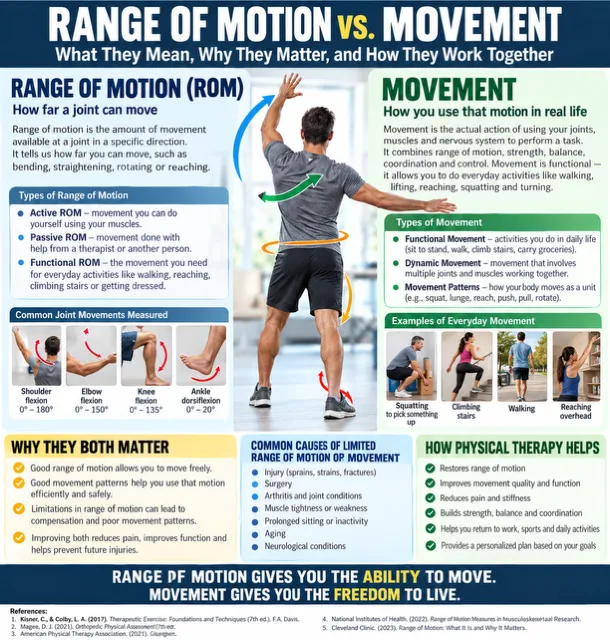
Range of motion (ROM) refers to how far a joint can move in a particular direction. It is commonly measured in degrees and helps physical therapists evaluate joint flexibility, mobility, and limitations.
There are several ways to assess range of motion:
- Active range of motion: Movement performed using your own muscles without assistance.
- Passive range of motion: Movement performed with assistance from a physical therapist or another person while your muscles remain relaxed.
- Active-assisted range of motion: Movement performed with partial assistance when you cannot complete the motion independently.
For example, raising your arm overhead involves shoulder range of motion. If an injury, surgery, or joint condition prevents you from lifting your arm fully, your available range may be limited.
What Is Movement?
Movement involves more than the ability of a joint to bend or rotate. It requires multiple body systems to work together, including muscles, joints, nerves, balance, strength, and coordination.
Consider walking up a flight of stairs. Your knees and hips need adequate range of motion, but you also need sufficient muscle strength, balance, and control to complete the activity safely.
Someone may have excellent joint flexibility but still struggle with everyday activities because of weakness, pain, or poor coordination.
Why Do Both Matter?
Healthy range of motion helps make movement possible. Effective movement allows you to use that mobility in everyday life.
Limitations can develop from injuries, arthritis, surgery, prolonged inactivity, neurological conditions, or age-related changes.
When one joint cannot move adequately, other parts of the body may compensate. Over time, these altered movement patterns can contribute to discomfort, inefficient movement, and difficulty performing normal activities.
How Physical Therapy Can Help
Physical therapists evaluate both joint mobility and functional movement to identify limitations and develop individualized treatment plans.
Depending on the patient’s needs, treatment may include stretching, strengthening exercises, joint mobilization, balance training, and functional movement activities.
The objective is not simply to improve flexibility. It is to help patients move more comfortably, maintain independence, and return to activities that matter to them.
The Importance of Maintaining Mobility
Maintaining mobility becomes increasingly important as we age. Regular physical activity, appropriate strengthening, and attention to joint function can support independence and overall quality of life.
Whether recovering from an injury, managing a chronic condition, or trying to remain active, understanding the relationship between range of motion and movement is an important part of maintaining physical health.
Range of motion gives you the ability to move. Movement gives you the freedom to live.
Health Is a Wealth — Connecting people with health, wellness, medical, and fitness professionals.
References
- Kisner, C., Colby, L. A., & Borstad, J. Therapeutic Exercise: Foundations and Techniques. F.A. Davis.
- Magee, D. J. Orthopedic Physical Assessment. Elsevier.
- American Physical Therapy Association. Guide to Physical Therapist Practice.
- National Institute on Aging. Exercise and Physical Activity.
- Cleveland Clinic. Range of Motion: What It Is and Why It Matters.