How to Punch Faster Without Losing Power or Accuracy
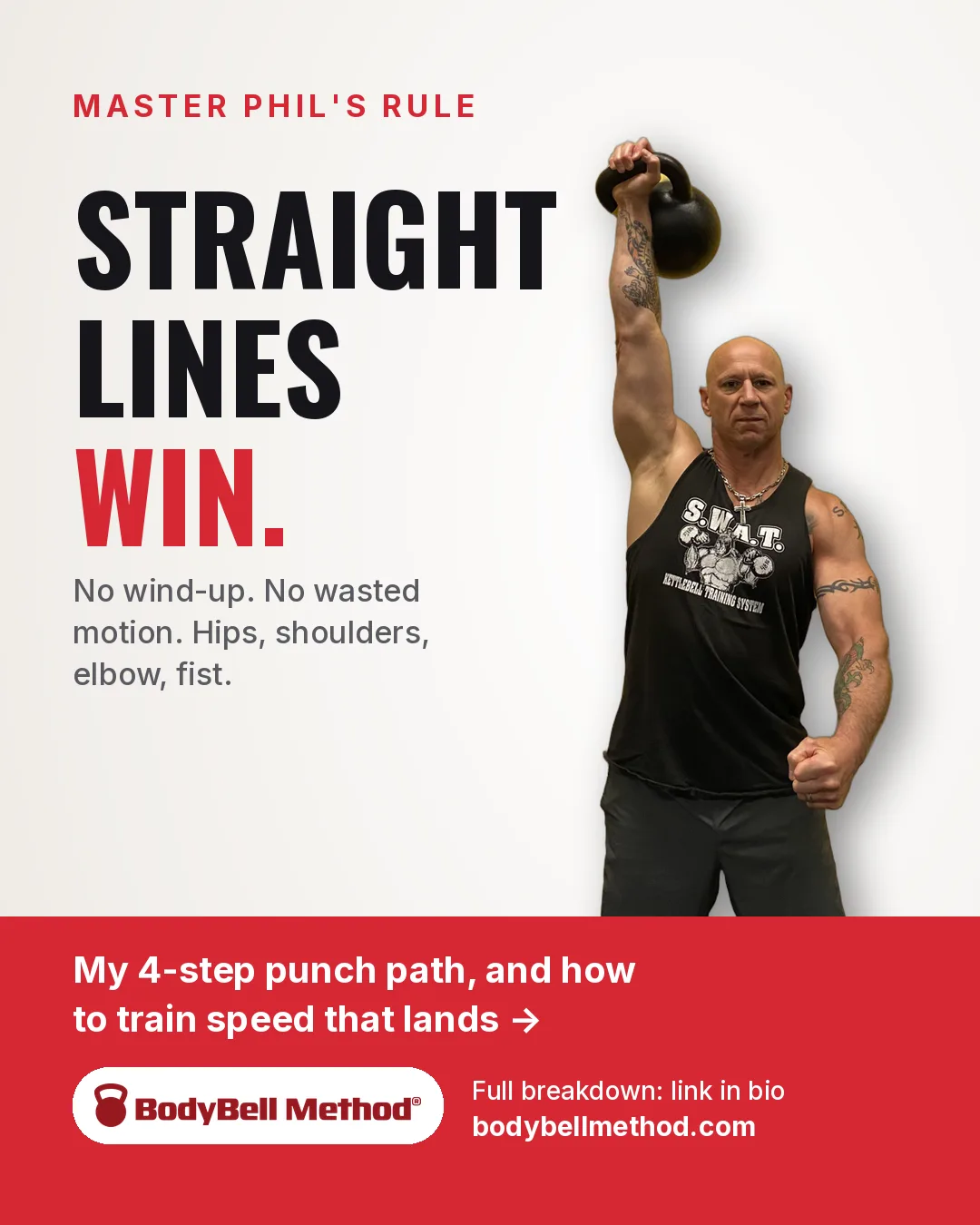
To punch faster without losing accuracy or power, shorten the path, not the effort. A fast punch is a straight punch: it starts at the hips, travels through the shoulder and elbow in one line, and lands without a wind-up or wasted motion. Speed you can't aim and can't defend from is just a fast miss.
I have trained fighters for a long time, and I wrote about this during my graduate work in motor learning. Here is what the fastest effective strikers in history did, what the science says, and how to train it.
Why don't the “world's fastest punches” work in a real fight?
Search online and you'll find plenty of people claiming the world record for punching speed. When I timed several of those viral clips, the punches worked out to roughly 100 to 110 milliseconds each. That's quick.
But watch closely. Most of those strikes have:
- No hip rotation, so there's no power behind them.
- No lock-out of the body, so the punch isn't connected to anything.
- Little or no defensive posture, so the puncher is wide open.
- Targets inches away, with one punch running into the next.
Fast, yes. Useful, no. And here's the part people forget: we are most vulnerable when we are attacking. Every time your arm is extended, you've opened a door for your opponent. A punch that is fast but has no control will often miss, and a miss leaves you exposed.
How fast was Muhammad Ali's jab?
In 1969, Sports Illustrated timed Ali's jab. He stood ready while a light flashed, then jabbed at a board 16½ inches away. His fist covered that distance in about 4/100 of a second, which the magazine compared to the blink of an eye.
What matters most to me is not the number. Ali threw that jab from his lead hand, out of a stance he could defend from. Fast, accurate, and safe. That is useful speed.
Was Bruce Lee really too fast for the camera?
By several accounts, yes. Lee's biographers and his son Brandon described how some of his fight scenes on The Green Hornet had to be slowed down so audiences could actually see the movements. Like Ali, Lee did his damage with the lead hand, and his punches often traveled a longer distance.
Lee also learned from Ali. According to Enter the Dragon director Robert Clouse, Lee studied Ali's fight films in front of a mirror, move by move.
Who was faster? Honestly, who cares. Both showed the upper limit of speed that still works.
What did Bruce Lee say about punching speed?
Lee put it plainly in Tao of Jeet Kune Do: “The leading straight punch is the fastest of all punches.” He also explained why it lands so often: “because it goes straight toward the target, it has a better chance of landing.”
And this is the line I want every athlete to remember: “Many fighters fail to appreciate how much true speed depends on economy of motion.”
What is economy of motion in punching?
Economy of motion means taking the straightest path to the target with no wasted movement. No cocking the arm back. No looping. No extra shoulder shrug before the punch. Every inch you add to the path is time your opponent gets to see it coming.
There's a reaction-time reason too. Research known as Hick's law shows that the more choices you're juggling, the longer it takes to respond. A simple, straight punch that you've drilled until it's automatic is one less decision to make in the moment. (Reaction time and age is coming in a later post.)
Why do faster punches get less accurate? (Fitts' law)
In 1954, psychologist Paul Fitts showed what every athlete feels: there's a trade-off between speed and accuracy. The farther you have to move and the smaller the target, the longer an accurate movement takes. Go faster than your skill allows and your accuracy drops.
Think about signing your name. Do it slowly and it's neat. Rush it and it turns into a scribble. Punching works the same way.
The good news: that trade-off isn't fixed. Through proper practice and repetition, speed can be increased and a level of accuracy maintained. That's motor learning, and it's the same reason skill keeps improving with age when you practice the right way (I covered that in Build Muscle After 50: Why Motor Control Matters and Learning to Move Better After 50).
How do you throw a faster straight punch? (4 steps)
All of the power in a punch is delivered from the hips, and it travels in a chain. Get each link in line and the punch is fast, accurate, and protected.
- Hips. The punch starts here. Rotate the hips toward the target so the whole body is behind the strike, not just the arm. (Where punching power really comes from is its own post, coming soon.)
- Shoulders. Decide which punch you're throwing, then engage your lats and pack the shoulder down and back. A packed shoulder keeps the punch connected to your body instead of floating out on its own.
- Elbow. This is where many people fail. Shoot the elbow straight toward the target, in line with the shoulder. No flaring out to the side. A flared elbow turns a straight punch into a loop, and loops are slow and easy to see.
- Fist. Drive the fist straight to the target. If you need to cover more distance or add power, step forward with the punch instead of reaching. Then bring it straight back to your guard.
What drills make your punches faster?
These are the drills I'd start with. Speed comes from clean reps, not from trying harder.
- Slow to fast. Throw the punch slowly in perfect form, hips to fist. Only add speed when the path stays straight.
- Big target, then small. Start on a big pad or bag area, then shrink the target as your accuracy holds. That's Fitts' law working for you.
- Shadowbox. Lee called shadowboxing “a method for building up speed.” Watch yourself in a mirror like Lee watched Ali, and look for loops and flared elbows.
- Stay relaxed. Lee warned that beginners “try too hard—to hurry, strain, press.” Tension slows you down. Relax until the moment of impact.
- Always return to guard. The rep isn't over until your hand is back home protecting your face.
Frequently asked questions
How do I punch faster without losing accuracy?
Shorten the path. Throw straight punches from the hips through the shoulder, elbow, and fist in one line, with no wind-up. Build speed gradually with slow-to-fast reps so your accuracy keeps up.
Why do my punches miss when I throw them fast?
That's the speed-accuracy trade-off described by Fitts' law. When you move faster than your skill allows, accuracy drops. Practice and repetition let you raise speed while keeping accuracy.
Is the jab the fastest punch?
Bruce Lee called the leading straight punch “the fastest of all punches” because it goes straight to the target from the hand closest to it. Ali's jab was timed at about 4/100 of a second over 16½ inches.
Does a faster punch mean a harder punch?
Not by itself. Many viral “fastest punch” clips show no hip rotation and no power. Speed and power both come from good mechanics, starting at the hips.
Can you get faster after 50?
Yes. Motor skills keep improving with the right practice at any age. Clean, consistent repetitions are what make a movement faster and more accurate.
The bottom line
Fast isn't enough. Useful speed is a straight line from your hips to your fist, thrown from a stance you can defend, and built through smart, repeated practice. Ali and Bruce Lee had it. You can train it.
If you want a program that builds that hip-driven strength, coordination, and conditioning at any age, the Body Bell Method coaches you step by step, and the Master Phil app puts the workouts in your pocket. Visit bodybellmethod.com to get started.
References
- Fitts, P. M. (1954). The information capacity of the human motor system in controlling the amplitude of movement. Journal of Experimental Psychology, 47(6), 381–391. https://doi.org/10.1037/h0055392
- Hick, W. E. (1952). On the rate of gain of information. Quarterly Journal of Experimental Psychology, 4(1), 11–26. https://doi.org/10.1080/17470215208416600
- Kane, M. (1969, May 5). The art of Ali. Sports Illustrated. Republished at https://www.si.com/boxing/2015/09/24/muhammad-ali-boxing-art
- Lee, B. (1975). Tao of Jeet Kune Do. Ohara Publications.
- Clouse, R. (1987). The Making of Enter the Dragon. Unique Publications.
- Schmidt, R. A., & Lee, T. D. (2011). Motor Control and Learning: A Behavioral Emphasis (5th ed.). Human Kinetics.
Adapted from Phil Ross's graduate coursework in motor learning (2017), updated with verified sources for 2026.